UX Research · Digital Wellbeing · Product Strategy
SIFT UX Research
An idea I couldn't shake: getting underneath digital overwhelm and algorithmic distrust to figure out what a healthier alternative could actually look like.
The Context
SIFT started as a hunch of my own: that people were exhausted by their feeds, not supported by them. Across social platforms, I kept seeing the same pattern, people feeling shaped by algorithms they didn't trust, coming away drained and overstimulated with no real sense of how to protect their own wellbeing. So I decided to research it myself.
The Ask
I set myself the task of understanding how people actually experience digital overload emotionally, what triggers push a scroll session into a spiral, and what "healthy content" could even mean in practice, then designing research that could surface the behavioral patterns and trust conditions a concept like SIFT, a content "sifter," would need to work.
That research became the early product direction for SIFT itself, showing me exactly where intervention would help people and where it would just get in the way.
The Work
I set the frame before I asked a single question.
I built the structure for exploring emotional impact, overwhelm, and algorithmic distrust first, so I'd know how to interpret what "draining" and "nourishing" actually meant to the people I talked to.
Then I built a way to surface how people really feel about what the algorithm serves them.
I created interview and walkthrough protocols and used generated participant data to model emotional response patterns and how people expect the algorithm to behave.
I also looked at what was driving the system, not just how it felt to use it.
That meant considering the ethical impact of the platforms themselves, how business models built on advertising and data mining shape what gets served and why, and what that means for the people caught inside the loop.
The themes clustered on their own.
Through affinity mapping I found the core patterns: overstimulation, loss of agency, identity strain, distrust, the real tension points in people's digital experience.
I turned patterns into people.
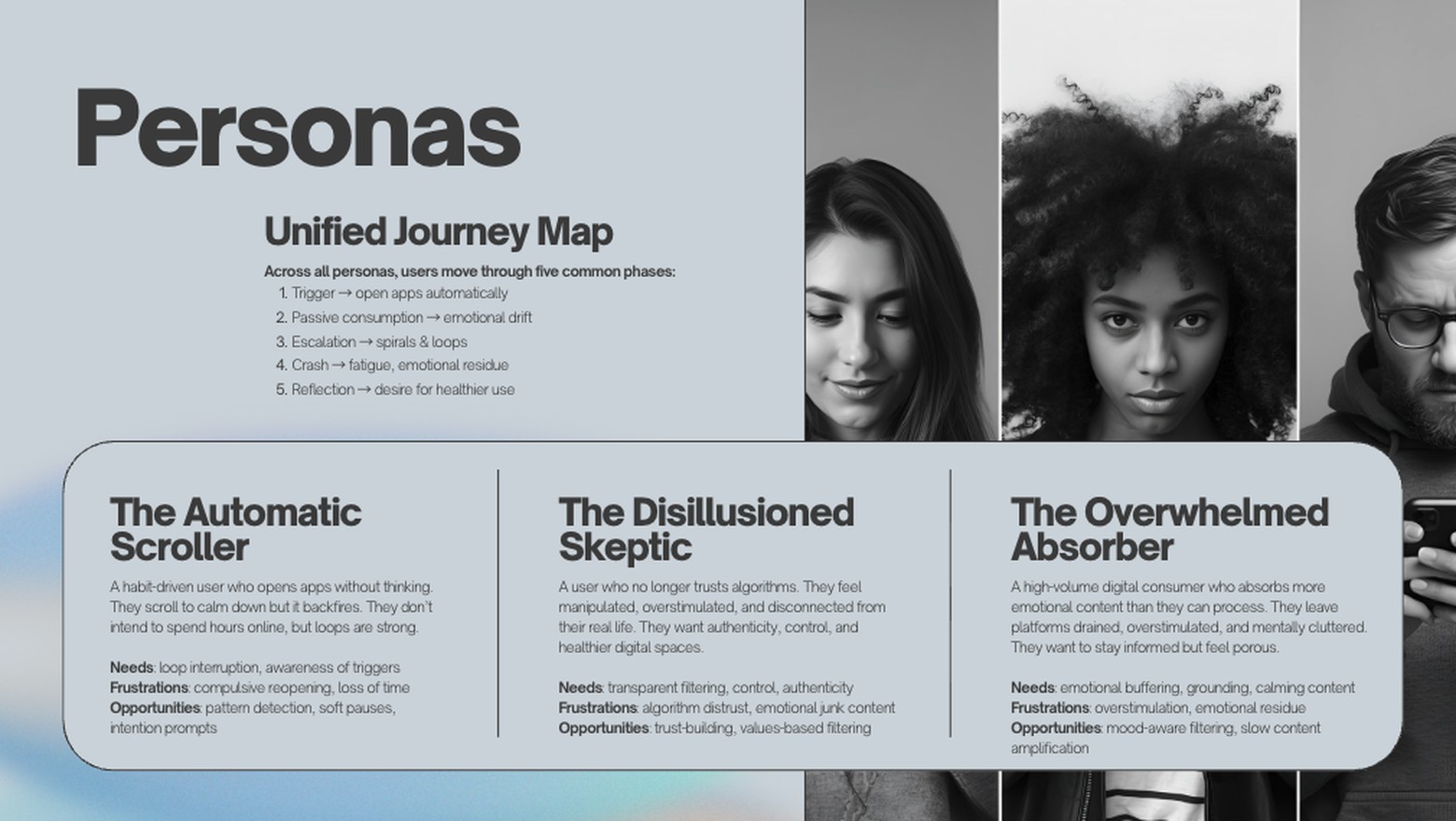
I translated what I'd modeled into three personas and a five-phase journey, mapping exactly where things escalated and where a gentler intervention could step in.
And pointed at where to build first.
I highlighted the highest-value opportunities: emotional-state cues, soft loop interruption, transparent filtering, and calm content pathways, to guide SIFT's initial design.
The Outcome
Here's where it landed:
Opportunity Areas Identified
Each one pointed to a concrete design decision, on emotional cues, loop interruption, or transparent filtering, that shaped where SIFT went first.
Modeled Participants
Even across very different people, I kept hitting the same patterns: overwhelm, saturation, and trust gaps that shaped what every persona actually needed.
Insight Clusters Synthesized
I turned these into a framework I could keep coming back to, one built around user needs, trust standards, and decisions grounded in how people actually feel.